Understanding the role played by steel protection, preventive maintenance and environmental conditions in maximising the durability of grain storage facilities.
A steel silo is a long-term investment. Beyond its storage capacity and technical specifications, one of the most important considerations when selecting a storage solution is its expected service life.
How long can a galvanised steel silo last? There is no single answer. Its durability depends on several interrelated factors, including the quality and thickness of its protective coating, the environment in which it operates, its design and the maintenance it receives throughout its service life.
Galvanised steel offers an effective and proven solution for protecting steel against corrosion. However, not all protective coatings perform in the same way, and understanding their characteristics is essential when specifying a silo for a particular location.
At SYMAGA, the selection of materials and protection against corrosion are key considerations in the engineering and manufacture of storage solutions. Let’s analyse the six main factors that determine how long a galvanised steel silo can remain in service.
1. The importance of galvanisation: the Z600 and ZM310 coatings and the duplex system
The first factor influencing the durability of a steel silo is the protection applied to its steel components.
Galvanisation protects steel against corrosion by creating a metallic barrier that separates the steel from its surroundings. Zinc also provides sacrificial protection: if the coating suffers localised damage, the zinc corrodes preferentially, helping to protect the exposed steel.
Two important coating specifications to bear in mind are Z600 and ZM310.
Z600: high-protection zinc coating
Z600 is a zinc coating designation associated with a total coating mass of 600 g/m² on both sides of the steel sheet. Its high zinc content provides a protective layer designed to offer long-term corrosion resistance.
The thickness of the zinc coating is particularly important because, under comparable environmental conditions, a thicker coating generally means a longer period before maintenance is required.
When discussing zinc coatings, the question often arises: how much longer does Z600 last compared to coatings with a lower zinc content?
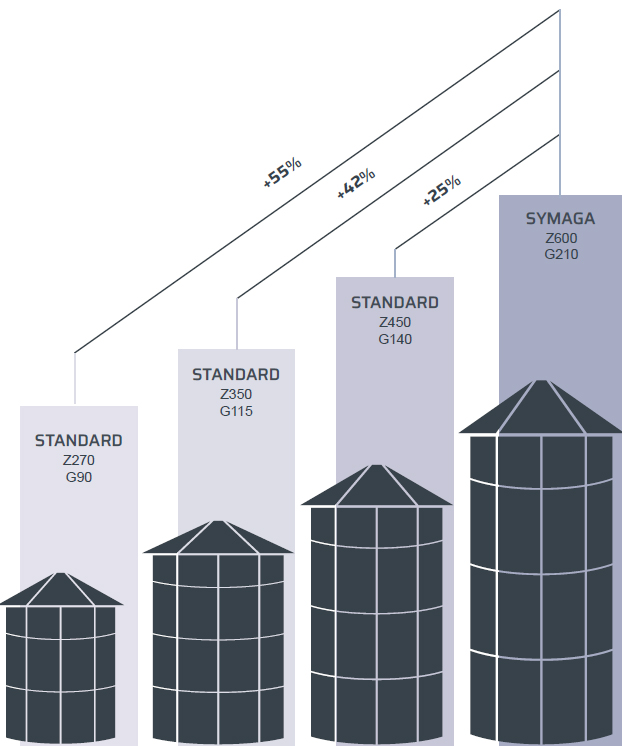
The difference in zinc coating thickness has a direct impact on long-term corrosion protection. The Z600 coating provides 600 g/m² of zinc, compared with 450 g/m² for Z450 and 300 g/m² for Z300.
According to the proportional relationship between zinc coating thickness and service life, as set out in ISO 14713-1, the Z600 can offer approximately 35 per cent longer service life than the Z450 and up to twice that of the Z300, under the same atmospheric exposure conditions.
This translates into a longer-lasting protective capacity for the steel, bearing in mind that the actual service life will depend on the environmental corrosivity category and the operating conditions of the installation.
ZM310: advanced zinc-aluminium-magnesium protection
ZM310 is a metallic coating composed of zinc, aluminium and magnesium, with a total coating mass of 310 g/m² on both sides.
The addition of aluminium and magnesium improves the coating’s corrosion resistance. One of its key features is the enhanced protection it offers at cut edges and in areas where the coating has suffered localised damage, thanks to the protective corrosion products formed by its alloy composition.
Unlike conventional zinc coatings, zinc-aluminium-magnesium coatings combine barrier protection with additional corrosion protection mechanisms.
Duplex system
This involves combining two protective layers on the steel: first, galvanisation using a coating such as Z600 or ZM310, followed by a layer of paint comprising a primer and topcoat system. This not only adds the protection of both layers but multiplies it, resulting in a service life that is significantly longer than that of either system on its own. In highly aggressive environments or when it is necessary to extend the intervals between maintenance, the duplex system stands out for its excellent performance.
2. Preventive maintenance: protecting your investment
Galvanised steel is a material that requires little maintenance, but ‘little maintenance’ does not mean ‘no maintenance’.
Preventive maintenance helps to identify potential problems before they develop into more serious damage. A well-planned maintenance programme can preserve the protective coating, maintain the silo’s structural integrity and reduce unexpected repair costs.
Some recommended maintenance practices include: Maintenance activities should continue to be carried out regularly to protect your investment.
- Surface cleaning: Remove accumulated dust, dirt and other deposits that may retain moisture or create localised corrosive conditions.
- Inspection of drainage systems: Ensure that rainwater can drain away properly and does not accumulate around the base of the silo.
- Ventilation maintenance: Check that ventilation systems are functioning correctly to help control humidity and prevent condensation inside the silo.
- Inspection of joints and seals: Inspect connections, access doors and sealing elements for any deterioration or water ingress.
- Repair of minor damage: Repair damaged protective coatings using suitable products and following the manufacturer’s recommended procedures.
3. Regular inspections: early identification of problems
Preventative maintenance and regular inspections go hand in hand. Whilst maintenance focuses on keeping the facility in good condition, inspections provide a systematic assessment of its overall performance.
A structured inspection programme facilitates the detection of the early signs of corrosion, mechanical wear or structural deterioration.
Particular attention should be paid to: The frequency of inspections should be tailored to the installation’s location, operating conditions, age and exposure to corrosive agents. More demanding environments require closer monitoring.
- Roof and upper sections: Check for water ingress, corrosion, damaged panels and deterioration around roof joints.
- Wall panels: Look for scratches, damage to the coating, pitting or deformation.
- Bolted joints: Check for loose, missing or deteriorated fasteners and inspect the condition of the sealing elements.
- Base and foundations: Examine areas exposed to water accumulation, damp and contact with surrounding materials.
- Access equipment: Inspect ladders, platforms, handrails and safety equipment.
- Ventilation and fittings: Check that ventilation systems, ventilation ducts and other equipment are maintained in good working order.
Where necessary, a qualified technician must assess the condition of the steel and the protective coating and recommend corrective measures.
4. Environmental factors affecting the durability of steel
The environment surrounding a silo directly influences the rate at which corrosion develops.
Two silos made of identical materials and to the same specifications may have different service lives simply because they operate in different environmental conditions.
The main factors to consider are:
Moisture and condensation
Prolonged exposure to moisture increases the risk of corrosion. Condensation can occur when temperature differences cause water vapour to accumulate on steel surfaces, particularly inside storage facilities.
Therefore, proper management of ventilation and aeration is important to protect both the stored product and the silo structure.
Coastal environments and exposure to salt
Wind-borne salt particles can accelerate corrosion, particularly in facilities near the sea. Chlorides can impair the protective performance of zinc-based coatings, making the appropriate selection of materials and their inspection particularly important.
Industrial pollution
Atmospheric pollutants, particularly sulphur compounds, can increase the corrosiveness of an environment and accelerate the deterioration of protective coatings.
Temperature variations
Temperature fluctuations can contribute to condensation and the build-up of moisture. Their effects depend on the local climate, the silo’s operating conditions and its ventilation system.
Dust and aggressive substances
In certain industrial and agricultural applications, deposits of dust, fertilisers or other substances can create localised conditions that promote corrosion, particularly when combined with moisture.
For this reason, the selection of protective coatings must always take into account the specific environment of the installation. International standards such as ISO 9223 and ISO 14713 provide useful guidance for assessing atmospheric corrosivity and selecting suitable zinc protection systems.
5. Best practices for maximising the service life of a silo
Long-term durability is not determined solely by the protective coating. It is the result of decisions made throughout the entire life cycle of the installation, from engineering and manufacture through to assembly, operation and maintenance.
The following practices help to maximise the service life of a galvanised steel silo: A silo designed for long-term operation requires a comprehensive approach in which the quality of materials, engineering and maintenance work in tandem.
- Certified coating. Use a raw material that complies with galvanising standards.
- Prioritise sound engineering and design. Proper structural calculations, a detailed definition of the structural elements and appropriate material specifications help to ensure reliable performance under the anticipated operating conditions, but technical advice should not stop there. In certain environments, investing more at the outset in features such as a double-walled structure, thermal insulation, an internal lining or a duplex coating system can extend the silo’s service life by many years and make the project a much more cost-effective option in the long term.
- Ensure correct assembly. Follow the manufacturer’s assembly instructions and use the specified components, fixings and sealing systems.
- Avoid unnecessary damage to protective coatings before the facility is commissioned. The correct storage of parts prior to assembly is a key factor that is often overlooked. Failure to follow the manufacturer’s recommendations can affect the thickness of the galvanised coating, thereby reducing its service life, without this being detectable by a simple visual inspection. Furthermore, handling, transporting and assembling steel components with care is another key aspect. Any damage must be assessed and repaired in accordance with approved procedures.
- Monitor humidity and condensation. Maintain adequate ventilation and air circulation, and ensure that drainage systems are functioning correctly.
- Establish a preventive maintenance programme. Schedule regular inspections and resolve minor issues before they become serious problems.
- Rely on technical support. Work with qualified specialists when assessing the condition of the coating, structural performance or repair requirements.
6. The economic benefits of greater durability
The service life of a silo has a direct impact on the overall profitability of a storage investment.
A certified-quality protective coating and an appropriate maintenance strategy may represent an additional investment initially, but their benefits become increasingly significant over time.
Lower maintenance and repair costs
Effective protection against corrosion reduces the likelihood of premature deterioration and the need for extensive repairs or component replacement.
Longer asset lifespan
Extending a silo’s lifespan allows the initial investment to be spread over a greater number of years, thereby improving its long-term economic performance.
Fewer operational disruptions
Unexpected repairs can disrupt storage operations and affect the facility’s availability. Preventative maintenance and durable materials help to minimise these risks.
Greater protection and quality of the contents
The condition of the silo directly influences the quality of the stored product. A deteriorated structure can allow moisture to enter, encourage the growth of mould or pests, and alter the properties of the contents. Conversely, a silo in good condition acts as a reliable barrier and keeps the product intact.
Greater investment security
A storage facility is a strategic asset. Its reliability and structural integrity are essential for protecting the stored grain and maintaining operational continuity.
Greater long-term value
When evaluating a silo, the purchase price should not be the only factor to consider. The total cost of ownership – which includes maintenance, repairs, operational availability and expected service life – provides a more comprehensive view of its economic value.
Ultimately, investing in durability means investing in the long-term reliability of the entire storage operation.
Conclusion: durability begins with the right decisions
How long does a galvanised steel silo last? Its service life depends on the quality of its protective coating, the environmental conditions in which it operates, its engineering and assembly, and the maintenance it receives.
Choosing certified galvanisation, with Z600 or ZM310 coatings, is an essential starting point. However, long-term performance also requires proper design, professional installation, regular inspections and preventive maintenance.
At SYMAGA, we believe that reliable storage begins long before a silo is installed. The selection of raw materials, engineering expertise and technical support during assembly are fundamental to developing storage solutions designed to operate reliably in different environments around the world.
Because a silo is not just a storage structure. It is a long-term investment to protect the harvest.
SYMAGA – Reliable storage.
Fernando Rodríguez, Product Manager, SYMAGA